Wood Bottom Mill
Wood Bottom Mill was one of the earliest fulling mills in Marsden; originally called 'Whinny Hill Wood Mill'. In 1748, John Kaye's will to his son, John of Edgend, included 'the Whinhill Wood with the house and fulling mill in the wood bottom in the tenure of John Berry'.
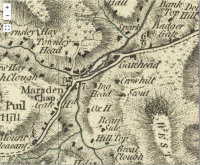
Jeffries map of Yorkshire, 1771
Click to enlarge
Thomas Jeffries Map of Yorkshire, published in 1771, shows two mills on the River Colne to the east of Marsden. The mill nearer to the centre of Marsden would be Frank Mill and the right-hand mill is almost certainly Wood Bottom Mill.
By 1771 it was occupied by James Hirst and owned by John Plowes, a Leeds merchant, who acquired it through marriage to Anne Kaye, the sister of Joseph Kaye who was the younger John Kaye's heir. It is likely that the mill's tenants from 1789 to 1801 were successively Edward Greaves and Richard Brown.

Fulling, Scribbling, and Rasping Mills to be LET
Manchester Mercury
22/03/1796
An advertisement in the Leeds Mercury in 1796 gives a description of the mill at that time. In addition to fulling the mill also now contained scribbling and carding machinery and there was an adjoining chipping and rasping mill for the preparation of dyewoods, a dyehouse, warehouse and 'sundry COTTAGES lately erected'. Power was supplied by two water wheels, 'one of which has Nine Feet Fall and being constructed in the best manner the Power of it is very great'.
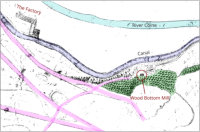
Wood Bottom Mill shown on the 1801 Township Map.
Click to enlarge
It looks like the mill was rebuilt around this time; an 1802 advertisement for sale describes the mill as 'Newly Erected',
'three storeys high and 16½ yards by 10 yards containing 4 scribbling engines, 3 carders, 2 billies, a teazer and fulling stocks all in good Repair being completely fitted up for Milling of Cloth, Scribbling Carding and Slubbing of Wool (constantly employed) and might be very easily converted into a Cotton Mill'.
The mill was said to benefit from a never ending supply of water, was close to the canal and turnpike road and, 'being in a populous neighbourhood and where plenty of hands may be had at much lower wages than at most other places'.
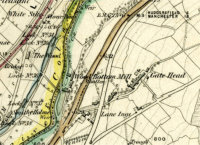
Wood Bottom Mill shown on the 1854 Ordnance Survey map.
Click to enlarge
It was bought by one of its occupants, John Haigh, who had it until he went bankrupt in 1806. In 1812, Arthur Hirst of 'Whinnel Wood Mill' is identified as a 'carding-engineer' who fortified the mill against Luddite attacks by barricading the windows and doors, and arranging that the ground floor could be sealed off from above. Defenders could fire on rioters from the upper windows. In 1816, John Barber is identified as being 'of Whinny Wood Mill, Fulling Miller'. The next owners were Enoch and Joseph Armitage who had the mill until bankruptcy in 1849. In 1848 they were described as carrying on fulling and scribbling at 'Wood Bottom Mill'.
By 1860 the mill was owned by Abraham Hirst from Leeds and occupied by a woollen manufacturer, John Hirst. Jones's Mercantile Directory of Halifax and Huddersfield for 1863-64 lists the following;
| Hirst Arthur | woollen mfr, Wood bottom | |
| Hirst Enoch | woollen manufacturer, Wood bottom mill | |
| Hirst John | woollen mnfr, Wood bottom mill | |
| Hirst, Lockwood & Hirst | scribblers and fullers, Wood bottom mill | |
| Hirst, Stockwell & Hirst | Woodbottom mill, Marsden |
Serious Fire at Marsden
Leeds Mercury
22/07/1862
The Leeds Mercury on January 19th, 1860 reported a fire which burnt down a two-storey building at the mill. Just two years later, in July 1862, another fire gutted the south end of the mill and destroyed a large quantity of machinery. Further fires in 1866 and 1867 led to demolition and machinery being sold.
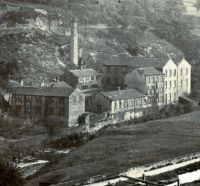
Wood Bottom Mill c1890.
Click to enlarge
In 1868 a 'newly erected mill' was to be let; plus a spinning mill, warehouse, dyehouse, five cottages and 16 acres of land. A photograph, from around this time, shows the addition of a mill chimney. Whether this was to service a steam engine or for another process is not known. The cottages were let, in 1870, to Irish labourers who were working on the Standedge railway tunnel. The mill was taken over in 1886 by Walter Hartley who put in additional machinery and employed more workers during 'a period of exceptional depression.'
The 1908 and 1949 Ordnance Survey maps of Marsden show the mills as 'disused'.
Later it was owned by John Martindale who ran a successful car maintenance/repair shop on the ground floor of the mill for many years. His son Jamie and his partner ran it after John retired. Since 1995 it has been owned by S.Eastwood (Excavations and Contractors).